How to get trade plates: a step-by-step DVLA guide


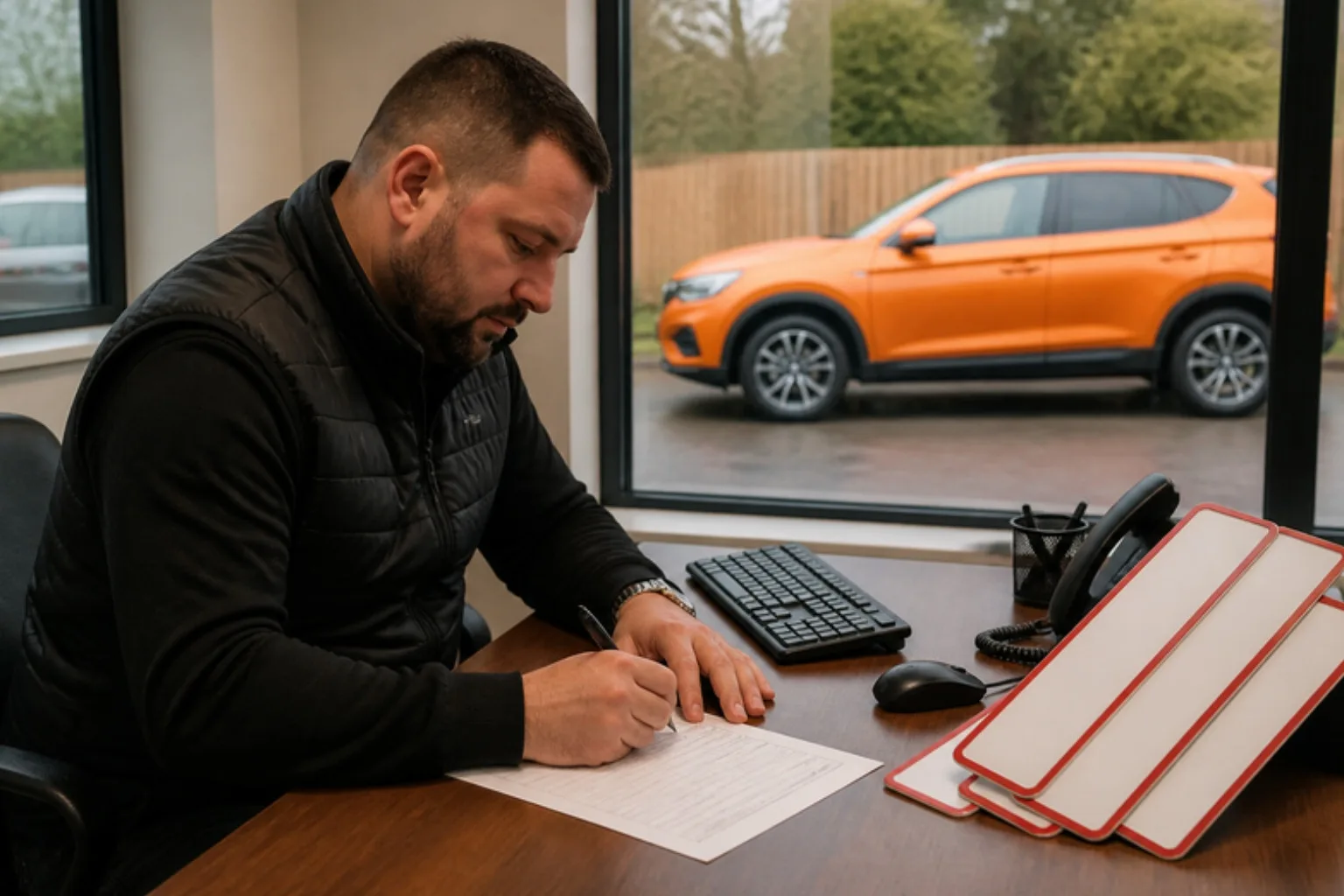
You apply to the DVLA for a trade licence by post on form VTL301, with a copy of your Motor Trade Insurance Certificate and the fee. If you are approved, GOV.UK says your plates and a confirmation letter should arrive within 4 weeks (GOV.UK, apply for a trade licence).
Only motor businesses can apply, and the fee depends on the month you send the form.
Who can apply for trade plates?
Motor dealers, motor traders and vehicle testers can apply. GOV.UK says your business must do at least one of these (GOV.UK, trade licence plates):
- sell vehicles
- manufacture or repair vehicles
- test other people’s vehicles on public roads
A business that collects or delivers vehicles also qualifies, as long as that is all it does, or it also makes or repairs vehicles.
What do you need before you apply?
The main thing you need is motor trade insurance, because the DVLA will not approve an application backed by a different type of policy. The name on your insurance certificate must match the name on the form (GOV.UK). Gather these before you start:
- A copy (not the original) of your Motor Trade Insurance Certificate. The DVLA cannot return documents. If you are still choosing cover, our trade plate insurance page explains the levels on offer.
- Your Companies House registration number, plus a reason, if you do not have a Motor Trade Insurance Certificate.
- The number of plate sets you want, and whether they are for cars and vans, motorcycles, or both.
- A short, accurate description of your business and exactly what the plates will be used for.
- A cheque or postal order made payable to “DVLA Swansea”. Altered or damaged cheques are not accepted.
- The month you want the licence to start. The form says not to send it more than 10 days before that date.
The last three points come from the form itself (DVLA form VTL301).
How do you apply for trade plates, step by step?
You download form VTL301 from GOV.UK, fill it in by hand and post it. DVLA says it is a print-only form that cannot be completed or sent digitally (GOV.UK, form VTL301).
- Download and print form VTL301. Use black ink and capital letters.
- In section 1, tick “a first trade licence”, choose motor trader, motor dealer or vehicle tester, and explain how you will use the plates.
- In section 2, give your business name exactly as it appears on your insurance certificate. A mismatch means the form is sent back.
- In section 4, enter the start month and the fee, then sign the declaration. A false declaration is an offence.
- Post the form, your fee and the insurance certificate copy to DVLA Swansea, SA99 1DZ.
- Wait up to 4 weeks. The plates and confirmation letter come separately, so contact DVLA if either has not arrived by then.
How much do trade plates cost?
A full 12-month licence for cars and vans costs £177, and a 6-month one costs £97.35. Every licence ends on 30 June or 31 December, so a first licence lasts between 6 and 12 months depending on when you apply. These are the DVLA rates shown on GOV.UK when we checked in November 2026 (GOV.UK, how much licences cost):
| Month you apply | Expires | Months | Cars, vans and other vehicles | Motorcycles, bicycles and tricycles |
|---|---|---|---|---|
| January (6-month) | June | 6 | £97.35 | £68.75 |
| January (12-month) | December | 12 | £177 | £125 |
| February or August | December or June | 11 | £177 | £125 |
| March or September | December or June | 10 | £162.25 | £114.60 |
| April or October | December or June | 9 | £146 | £103.10 |
| May or November | December or June | 8 | £129.80 | £91.65 |
| June or December | December or June | 7 | £113.55 | £80.20 |
| July | December | 6 | £97.35 | £68.75 |
The DVLA guidance notes warn that rates can change in the Chancellor’s Budget (VTL301G guidance notes), so check GOV.UK before you write the cheque. An 11-month licence costs the same as a 12-month one, so if you apply in February or August you pay the full-year rate. The licence fee is separate from what you pay for insurance.
A worked example: starting out in March
Ryan has just set up a small used car business near Doncaster. He buys stock at auction and wants to drive cars back to his unit without taxing each one. He arranges motor trade cover first, then posts a VTL301 in March. That buys a 10-month licence to 31 December at £162.25 (GOV.UK).
On the form he writes that the plates are for trips between auctions and his premises, and for buyers’ test drives. Those match permitted uses in the DVLA notes. He also checks two rules that could easily catch him out. He cannot leave a plated car parked on the street outside his unit, and he cannot use the plates on a car registered in his own name.
In December a renewal letter arrives. He renews for 12 months on form VTL318, again with a fresh copy of his insurance certificate.
What can you use trade plates for?
You can only use them for the purpose you wrote on your application. GOV.UK’s example is plates applied for customer test drives, which then cannot be used for anything else (GOV.UK, rules for using trade plates). The DVLA guidance notes list the permitted uses, including (VTL301G):
- testing or trialling a vehicle during building, modification or repair, or after it is finished
- a test drive for a likely buyer, going to any place and back
- delivering a vehicle to where the buyer will keep it, and demonstrating it at handover
- moving a vehicle to or from a garage, auction room or other place where vehicles are stored or sold
- trips to and from a workshop for bodywork, fitting, painting, repairs or valeting (not a public car wash)
- going to a place where it will be inspected, tested, shipped or broken up
The vehicle must also be roadworthy, insured, and have a valid MOT or be exempt. An unroadworthy vehicle has to be transported instead. Plates go on the front and back (just the back on a motorcycle), on the outside, readable from 20 metres.
What are you not allowed to do with trade plates?
Lending them out, splitting a set or using them outside the stated purpose are all offences under the DVLA notes (VTL301G, offences and penalties). The list includes displaying plates:
- after your trade licence has expired
- on a vehicle registered to you, unless you are a manufacturer using it for development work
- on a parked vehicle
- on a vehicle carrying passengers for hire, reward, commercial or personal reasons
- on a vehicle used for the general carrying of goods, apart from loads the regulations allow
Splitting a set across more than one vehicle, or letting another person use your plates, is also an offence. Letting someone else use them, or making a false declaration, carries a maximum fine of £5,000. Using plates for a purpose that is not permitted can bring a fine of up to £1,000 or 5 times the duty, whichever is higher.
Do trade plates insure the vehicle?
No. The licence covers tax and registration for permitted journeys, but the vehicle still has to be insured. That is usually the road risk section of a motor trade policy, which our road risk insurance page explains in more detail. Check that your policy covers vehicles driven on trade plates, and who is allowed to drive them. Policies vary, so read the wording or ask the insurer.
If you trade in your spare time, part-time motor trade cover is often built around road risk. Moving cars on a trailer for customers may need goods in transit insurance, and if customers visit your premises or driveway, look at public liability cover.
How do you renew, replace or return trade plates?
You renew on form VTL318, for 6 months if the licence ends in June, or 6 or 12 months if it ends in December (GOV.UK, renew). The DVLA sends a reminder letter, and you need to send a copy of your Motor Trade Insurance Certificate again.
- Lost or stolen plates: report it to the police, then apply on form VTL310 with the crime reference number. A replacement vehicle set costs £13.50, a motorcycle set £7 and both together £18 (GOV.UK, replace).
- New address: use VTL310 and keep your plates. New business name: apply again on VTL301 and return the old plates (GOV.UK).
- Closing down: send the plates back with form VTL308 and you get a refund for each full calendar month left (GOV.UK, end your licence).
Trade plate questions people often ask
How long does it take to get trade plates?
GOV.UK says a successful applicant can expect a confirmation letter and the plates within 4 weeks. They are sent separately, so contact DVLA if either is missing after that.
Can I get trade plates without a business?
No. Trade plates are issued to motor dealers, motor traders and vehicle testers, and the form asks you to describe your business. A private seller is not on the GOV.UK eligibility list.
Do I need motor trade insurance to get trade plates?
Yes, in almost every case. DVLA asks for a copy of your Motor Trade Insurance Certificate and will not approve an application backed by a different type of insurance. Without one, you must explain why and give a Companies House number.
Can I apply for trade plates online?
No. DVLA says form VTL301 is print only. You fill it in by hand and post it to DVLA Swansea, SA99 1DZ, with your fee and a copy of your insurance certificate.
How many sets of trade plates can I have?
You choose how many sets you want on form VTL301. You can apply for extra licences later on the same form, with another copy of your insurance certificate each time.
Can I use trade plates on my own car?
No. Displaying trade plates on a vehicle registered to you is an offence under the DVLA notes. The only exception is a vehicle manufacturer using its own vehicles for research and development.
Can I lend my trade plates to another trader?
No. Allowing another person to use your trade plates is an offence, with a maximum fine of £5,000. Splitting one set across two vehicles is also not allowed.
Do I get money back if I stop trading?
Yes. Return your plates to DVLA with form VTL308 before the licence expires and you get a refund for each full calendar month left. The application cannot be backdated.
What to do next
Sort your insurance before you post the form, because the DVLA checks the certificate. Our motor trade insurance hub sets out the different types of trade cover, and the trade plate cover page covers what to check on a policy.
When you are ready, compare motor trade insurance quotes with Tiger.co.uk using one short form. Tiger.co.uk compares quotes; it is not an insurer. Policies vary, so read the policy documents before you buy.
Fact-checked by Ian Wilson, Managing Director at Tiger.co.uk. 20+ years in price comparison; MEng, Queen’s University Belfast.